
isoformic is a workflow for isoform-level biological interpretation of transcriptomic data. It uses annotated transcripts and their types (protein coding, retained intron, nonsense-mediated decay, …) to describe how expression is distributed across the isoforms of each gene, and how that distribution changes between conditions.
The package is organised around the IsoformicExperiment class: a SummarizedExperiment-like container that keeps transcript, gene and exon level data for the same samples consistent, backed by Parquet files on disk and read through DuckDB.
Installation
install.packages("isoformic", repos = c("https://luciorq.r-universe.dev", getOption("repos")))The development version can be installed from GitHub:
# install.packages("pak")
pak::pak("luciorq/isoformic")
Quick start
library(isoformic)

# A bundled experiment: isoforms of 69 genes, 25 placenta samples, GENCODE v33
iso <- example_isoformic()
iso
#> <IsoformicExperiment> pe_placenta_example
#>   annotation : gencode_v33_example_subset (69 genes, 892 transcripts, 7,032 exons)
#>   samples    : 25 [condition]
#>   transcripts: 499 assayed from 69 genes
#>   assays     : abundance, counts
#>   gene assays: derived from transcript assays on demand
#>   DE results : det (499 transcripts), deg (69 genes)

# Three levels, one object
assay(iso, "abundance")[1:3, 1:3]   # transcripts x samples
gene_assay(iso, "abundance")[1:3, 1:3] # genes x samples, summed from isoforms
head(exon_table(iso, "RBPJ"))        # exon structures from the annotation

# Transcriptomic diversity
head(tx_diversity(iso))               # expressed isoforms, dominant isoform, effective number
head(transcript_features(iso))        # ORF, UTRs, NMD rule, promoters, splicing events vs canonical
head(transcript_productivity(iso))    # productive / altered / unproductive / noncoding, with reasons
head(productive_fraction(iso, group = "condition")) # productive share of each gene and its change
dominant_isoform(iso, group = "condition") # dominance switches between groups
isoform_switches(iso)                 # transcript vs gene level differential expression

# Plots
plot_log2fc(iso, feature = "RBPJ")
plot_tx_expr(iso, gene_name = "RBPJ", group = "condition")
plot_genomic_context(iso, gene_name = "RBPJ")
Any GFF3/GTF annotation works: GENCODE (GRCh38, GRCm39), Ensembl (all divisions), NCBI RefSeq (any assembly accession), MANE, FANTOM CAT / FANTOM6 (download_reference(reference = "fantom"), add_fantom_cat_tables()), the telomere-to-telomere T2T-CHM13 annotations (download_reference(reference = "t2t"), or the consortium’s Liftoff/CAT files whose GRCh38 identifiers are kept), HPRC per-haplotype CAT annotations (download_hprc_annotation() + merge_annotations() + haplotype_summary()), and long-read catalogs (StringTie, Bambu, FLAIR, with SQANTI3 categories through add_sqanti_classification()).
Your own data enters through one of three doors:
annot <- prepare_isoformic_annotation("gencode.v49.annotation.gff3.gz") # once, cached as Parquet
iso <- read_salmon(c(sample1 = "quants/sample1", sample2 = "quants/sample2"), annot_path = annot)
iso <- as_isoformic(se_from_tximeta, annot_path = annot)
iso <- IsoformicExperiment(annot_path = annot, assays = list(abundance = tpm_matrix), col_data = samples)

de_tx(iso) <- swish_results    # any tool's columns are standardised
de_gene(iso) <- deseq2_results
iso <- write_isoformic(iso, "my_experiment") # Parquet directory, restored with read_isoformic()
See the articles on the package website for the full workflow, from Salmon quantification to enrichment of transcript types.
How confident are we in an isoform-level result?
Salmon draws replicates from the posterior of the abundances (salmon_quant() asks for 30 Gibbs samples) and writes the equivalence classes. read_salmon(inferential = TRUE) or add_uncertainty() turn them into the uncertainty of each isoform (tx_uncertainty()), the pairs of isoforms that cannot be told apart (isoform_ambiguity()) and the stability of every fold-change over the draws (de_confidence(), with a high/moderate/low class), with plots (plot_de_confidence(), plot_isoform_correlation()), summary tables (uncertainty_report()) and a methods paragraph (uncertainty_methods()) for reporting. isoform_switches(confident_only = TRUE) keeps only the confident calls. inferential_overdispersion() and scale_counts() divide the read-ambiguity overdispersion out of the counts, test_usage() tests differential transcript usage with edgeR diffSplice, satuRn or DEXSeq on those counts, read_terminus_groups() brings in the groups of Terminus, and read_oarfish() reads long-read quantifications from Oarfish with their bootstrap replicates. The uncertainty article works through two real ESRP knockdown datasets (prostate cancer GSE129540 and H358 cells GSE75489): SCRIB-207 is a high confidence call, while the CD44 and CTNND1 switches have a certain direction but isoforms that the reads cannot tell apart.
Productive versus unproductive transcription
With transcript sequences in the annotation (extract_transcript_sequences() from a genome or transcript FASTA), productivity is computed from the sequence rather than read from the biotype: the canonical start codon is projected onto every isoform, translated, and checked for premature stops, frameshifts, non-stop decay and uORFs. External evidence (APPRIS principal isoforms, GENCODE Ribo-seq ORFs, validated NMD exons, GTEx tissue baselines, Pfam domain retention) comes from frozen, versioned datasets:
iso <- example_isoformic()                     # ships with sequences
transcript_orfs(iso, gene_name = "RBPJ")       # ORF, NMD class, coding probability
transcript_productivity(iso, gene_name = "RBPJ")
test_productive_fraction(iso, group = "condition")   # quasi-binomial test per gene
polya_sites(iso, gene_name = "RBPJ")           # alternative polyadenylation events
apa_usage(iso, group = "condition")

add_appris(iso); add_riboseq_orfs(iso); add_nmd_exons(iso)   # frozen datasets
productive_fraction(iso, group = "condition", reference = "Whole Blood")
Citation
If you use isoformic in publications, please cite:
Izabela Mamede, Lucio R Queiroz, Carlos Mata-Machado, Júlia Teixeira Rodrigues, Thomaz Luscher-Dias, Nayara E de Toledo, Paulo P Amaral, Luigi Marchionni, Gloria R Franco, Isoformic: a workflow for transcript-level RNA-seq interpretation, NAR Genomics and Bioinformatics, Volume 7, Issue 4, December 2025, lqaf176, https://doi.org/10.1093/nargab/lqaf176
Motivation
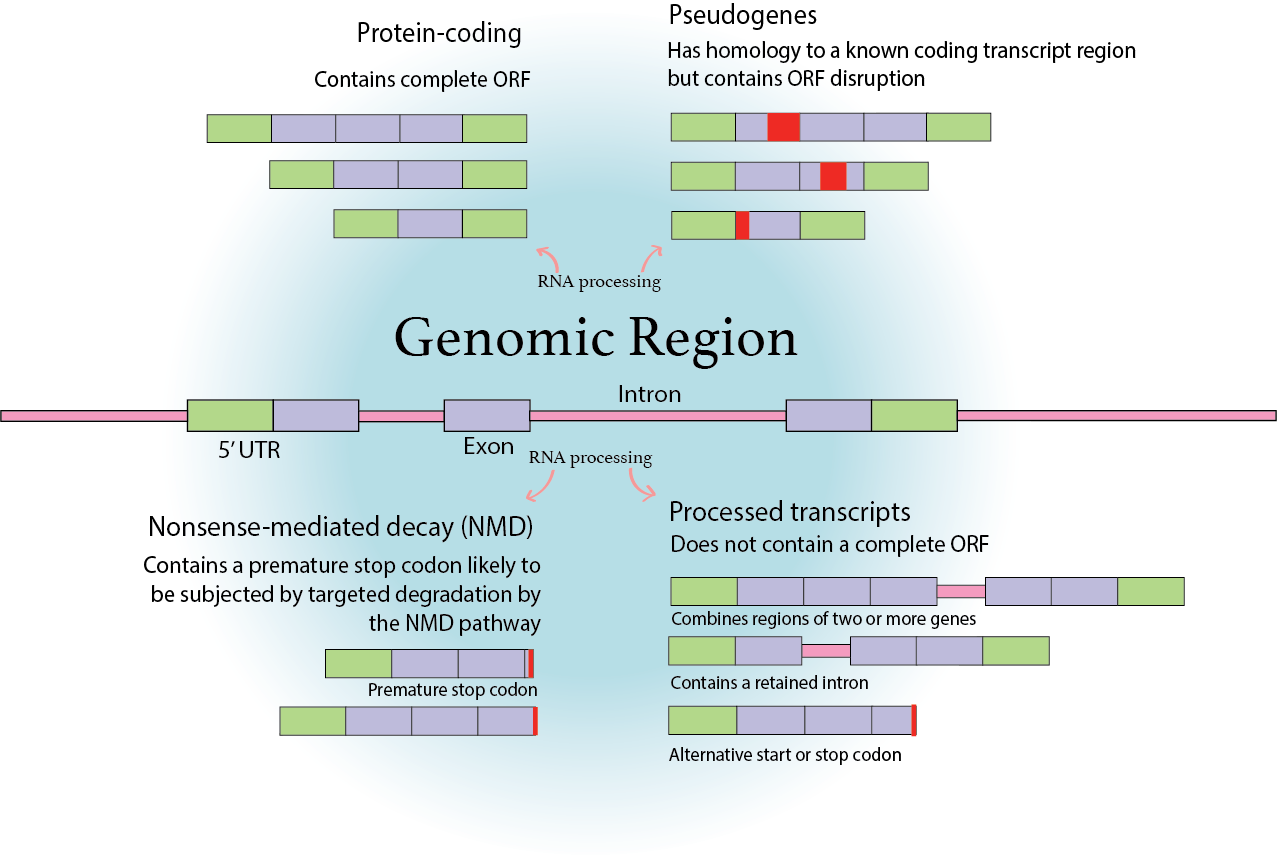
Differential expression at the isoform level, rather than at the gene level, captures regulation that gene-level summaries hide: alternative splicing and alternative transcription start sites produce isoforms with distinct structures and functions, and a gene whose total expression does not change can still switch from a protein coding isoform to an unproductive one. isoformic makes those changes visible by keeping transcript types, exon structures and gene-level summaries together and by testing each transcript category on its own during functional enrichment.