library(isoformic)
library(dplyr)

extdata <- fs::path_package("isoformic", "extdata")
annot_dir <- prepare_isoformic_annotation(download_reference(version = "33", file_type = "gff"))
iso <- IsoformicExperiment(
  experiment_name = "preeclampsia_placenta",
  annot_path = annot_dir,
  assays = list(abundance = read_parquet(fs::path(extdata, "pe_abundance.parquet"))),
  col_data = read_parquet(fs::path(extdata, "pe_col_data.parquet"))
)
de_tx(iso) <- read_parquet(fs::path(extdata, "pe_det.parquet"))
de_gene(iso) <- read_parquet(fs::path(extdata, "pe_deg.parquet"))
Isoform structure and productivity
October 17, 2026
Source:vignettes/articles/isoformic-productivity.qmd
Not every isoform of a coding gene makes the protein. Retained introns, poison exons and shifted stop codons produce transcripts that are degraded by nonsense-mediated decay (NMD) or translated into a different protein. This article derives the open reading frame (ORF) of every isoform, classifies each one as productive or not, quantifies the productive share of each gene’s expression, tests its change between conditions and brings in external evidence of translation and decay.
It starts from the object built in the introduction:
Structural features from the annotation
Beyond the biotype label, transcript_features() derives from the exon and CDS coordinates the ORF and UTR lengths, the distance from the stop codon to the last exon junction (the 50-nt rule of NMD), the promoter and 3’-end groups of each gene, the canonical isoform (MANE Select or Ensembl canonical) and the splicing events of every isoform relative to it:
feats <- transcript_features(iso, gene_name = "RBPJ")
feats[, c("transcript_name", "orf_length", "utr3_length", "stop_to_last_junction", "nmd_predicted", "tss_group", "n_skipped_exons", "n_retained_introns")]
#> # A tibble: 10 × 8
#>    transcript_name orf_length utr3_length stop_to_last_junction nmd_predicted
#>    <chr>                <int>       <dbl>                 <dbl> <lgl>
#>  1 RBPJ-222               283           0                  -131 FALSE
#>  2 RBPJ-201              1503        4121                  -316 FALSE
#>  3 RBPJ-206              1503           0                  -316 FALSE
#>  4 RBPJ-225                NA          NA                    NA FALSE
#>  5 RBPJ-204              1464          59                  -316 FALSE
#>  6 RBPJ-205              1461        4121                  -316 FALSE
#>  7 RBPJ-214              1398         176                  -316 FALSE
#>  8 RBPJ-208              1149         357                  -108 FALSE
#>  9 RBPJ-202              1461        4124                  -316 FALSE
#> 10 RBPJ-210                NA          NA                    NA FALSE
#> # ℹ 3 more variables: tss_group <int>, n_skipped_exons <int>,
#> #   n_retained_introns <int>
Productivity calls
transcript_productivity() turns those features into a graded call, each with its reason:
-
productive: complete ORF identical to the canonical one; -
altered_productive: complete ORF, no NMD, but a different protein; -
unproductive: no ORF, NMD predicted or an unproductive biotype; -
noncoding; -
uncertain: not enough information (for example an incomplete CDS annotation).
productive_fraction() is the share of a gene’s expression carried by productive isoforms, per condition, with its change. A gene whose total expression is flat while its productive fraction falls is regulated post-transcriptionally.
prod <- transcript_productivity(iso)
#> Warning: ! 91 transcripts have a sequence length differing from the exon length; their
#> ORFs are skipped.
table(prod$productivity)
#>
#> productive altered_productive unproductive noncoding
#> 18292 14271 24301 10123
#> uncertain
#> 5398
pf <- productive_fraction(iso, group = "condition")
head(pf)
#> # A tibble: 6 × 7
#> gene_id gene_name mean_gene_expr productive_fraction productive_fraction_…¹
#> <chr> <chr> <dbl> <dbl> <dbl>
#> 1 ENSG00000… SEC16B 9.63 0.561 0.963
#> 2 ENSG00000… RGPD6 741. 0.820 0.458
#> 3 ENSG00000… ACP7 16.2 0.337 0.677
#> 4 ENSG00000… RRM2 106. 0.766 0.439
#> 5 ENSG00000… AHNAK2 19.0 0.560 0.875
#> 6 ENSG00000… RPL18 3565. 0.658 0.970
#> # ℹ abbreviated name: ¹productive_fraction_preeclampsia
#> # ℹ 2 more variables: productive_fraction_control <dbl>,
#> # delta_productive_fraction <dbl>Sequence-aware ORFs
The annotation only describes the CDS it was given, and novel transcripts have none. extract_transcript_sequences() adds the spliced sequence of every transcript to an annotation directory, from a genome FASTA (which also covers novel transcripts of long-read or assembly annotations) or, as here, from the matching GENCODE transcript FASTA (the bundled example_isoformic() annotation already carries them).
With sequences, transcript_orfs() projects the canonical start codon of each gene onto every isoform and translates it, so the ORF, its stop codon, upstream ORFs, the frame relative to the canonical protein and the NMD class are computed rather than read from the annotation, and transcript_productivity() reports source = "sequence":
fasta_file <- download_reference(version = "33", file_type = "fasta")
#> ℹ '/home/runner/.cache/R/isoformic/gencode.v33.transcripts.fa.gz' already
#>   exists.
extract_transcript_sequences(annot_dir, transcript_fasta = fasta_file)
#> ℹ '/home/runner/.cache/R/isoformic/gencode_v33_chr_patch_hapl_scaff_annotation_gff3/annot_data_sequences.parquet'
#>   already exists; use `overwrite = TRUE` to replace it.
has_sequences(iso)
#> [1] TRUE
orfs <- transcript_orfs(iso, gene_name = "RBPJ")
orfs[, c("transcript_name", "orf_source", "orf_length", "stop_codon", "nmd_class", "n_uorf", "frame_vs_canonical", "coding_probability")]
#> # A tibble: 10 × 8
#>    transcript_name orf_source         orf_length stop_codon nmd_class n_uorf
#>    <chr>           <chr>                   <dbl> <chr>      <chr>      <int>
#>  1 RBPJ-222        annotation_partial        283 <NA>       <NA>           6
#>  2 RBPJ-201        annotation               1503 TAA        none           2
#>  3 RBPJ-206        annotation               1503 TAA        none           0
#>  4 RBPJ-225        projected                1140 TGA        none           0
#>  5 RBPJ-204        annotation               1464 TAA        none           0
#>  6 RBPJ-205        annotation               1461 TAA        none           5
#>  7 RBPJ-214        annotation               1398 TAA        none           0
#>  8 RBPJ-208        annotation               1149 TGA        none           4
#>  9 RBPJ-202        annotation               1461 TAA        none           4
#> 10 RBPJ-210        longest                   462 TAA        none           4
#> # ℹ 2 more variables: frame_vs_canonical <chr>, coding_probability <dbl>
prod <- transcript_productivity(iso, gene_name = "RBPJ")
prod[, c("transcript_name", "productivity", "reason", "source")]
#> # A tibble: 10 × 4
#>    transcript_name productivity       reason                              source
#>    <chr>           <fct>              <chr>                               <chr>
#>  1 RBPJ-222        uncertain          incomplete 3' end, no stop codon r… seque…
#>  2 RBPJ-201        productive         complete ORF identical to the cano… seque…
#>  3 RBPJ-206        productive         complete ORF identical to the cano… seque…
#>  4 RBPJ-225        unproductive       unproductive biotype                annot…
#>  5 RBPJ-204        altered_productive alternative start codon             seque…
#>  6 RBPJ-205        altered_productive alternative start codon             seque…
#>  7 RBPJ-214        altered_productive alternative start codon             seque…
#>  8 RBPJ-208        altered_productive alternative start codon             seque…
#>  9 RBPJ-202        altered_productive alternative start codon             seque…
#> 10 RBPJ-210        unproductive       unproductive biotype                annot…
orf_source records where the ORF came from: annotation (the annotated CDS, re-read from the sequence), projected (the canonical start codon projected onto the isoform), annotation_partial (a CDS flagged incomplete), longest (the longest ORF, when nothing could be projected) or none. coding_probability comes from a Fickett + hexamer logistic model trained on GENCODE coding and lncRNA transcripts; it decides whether a longest ORF is believable.
benchmark_productivity() measures the rules against the annotation biotypes: how many nonsense_mediated_decay and retained_intron transcripts the sequence rules alone call unproductive, and how many coding and canonical transcripts they call productive:
benchmark_productivity(iso)$summary
#> # A tibble: 5 × 4
#>   metric                                  n value source
#>   <chr>                               <int> <dbl> <chr>
#> 1 nmd_biotype_called_unproductive      5088 0.994 sequence
#> 2 retained_intron_called_unproductive 13074 0.569 sequence
#> 3 protein_coding_called_productive    38376 0.848 sequence
#> 4 canonical_called_productive         15242 0.963 sequence
#> 5 lncrna_called_noncoding              7343 1     sequence
Fractions, tests and uncertainty
productivity_fractions() splits each gene’s expression over the classes and, for unproductive isoforms, over the mechanism (NMD, retained intron, no ORF, non-stop decay).
test_productive_fraction() tests the change in productive fraction between two groups with a quasi-binomial model per gene. It runs on the counts assay when the object has one; this object only carries TPM, so the test is run on abundances here.
head(productivity_fractions(iso, group = "condition"))
#> # A tibble: 6 × 7
#> gene_id gene_name productivity fraction fraction_preeclampsia fraction_control
#> <chr> <chr> <fct> <dbl> <dbl> <dbl>
#> 1 ENSG00… TSPAN6 productive 1 1 1
#> 2 ENSG00… TNMD productive 1 1 1
#> 3 ENSG00… DPM1 altered_pro… 0.915 0.930 0.908
#> 4 ENSG00… DPM1 other 0.0394 0.0388 0.0396
#> 5 ENSG00… DPM1 uncertain 0.0460 0.0316 0.0528
#> 6 ENSG00… SCYL3 productive 0.720 0.614 0.770
#> # ℹ 1 more variable: delta_fraction <dbl>
head(test_productive_fraction(iso, group = "condition", assay = "abundance"))
#> # A tibble: 6 × 13
#> gene_id gene_name mean_gene_expr productive_fraction_…¹ productive_fraction_…²
#> <chr> <chr> <dbl> <dbl> <dbl>
#> 1 ENSG00… RPL35A 1749. 0.389 0.853
#> 2 ENSG00… UQCRB 856. 0.589 0.215
#> 3 ENSG00… RPL36A 1448. 0.985 0.929
#> 4 ENSG00… SKP1 3755. 0.548 0.641
#> 5 ENSG00… H3-3A 1555. 0.820 0.691
#> 6 ENSG00… SNX6 1302. 0.880 0.975
#> # ℹ abbreviated names: ¹productive_fraction_preeclampsia,
#> # ²productive_fraction_control
#> # ℹ 8 more variables: delta_productive_fraction <dbl>, log_odds_ratio <dbl>,
#> # se <dbl>, statistic <dbl>, dispersion <dbl>, df <dbl>, pvalue <dbl>,
#> # padj <dbl>productive_fraction() also accepts an expression floor (min_expr), Salmon inferential replicates (inf_reps, or metadata(iso)$inf_reps) for the uncertainty of each fraction, and a healthy-tissue reference from GTEx (below).
Poison exons and enrichment
Genes ranked by the change in productive fraction can be tested for enrichment directly, which targets regulated unproductive splicing such as AS-NMD. Exons found only in unproductive isoforms (poison exons) are listed by poison_exons() and outlined in the genomic context plot:
genesets <- read_gmt(fs::path(extdata, "c2.cp.reactome.v2023.1.Hs.symbols.gmt.txt"))
set.seed(42)
prod_enrichment <- run_productivity_enrichment(iso, genesets, group = "condition")
head(prod_enrichment[order(prod_enrichment$padj), c("pathway", "NES", "padj")])
#> # A tibble: 6 × 3
#>   pathway                                                            NES    padj
#>   <chr>                                                            <dbl>   <dbl>
#> 1 REACTOME_OLFACTORY_SIGNALING_PATHWAY                              1.99 2.29e-4
#> 2 REACTOME_INWARDLY_RECTIFYING_K_CHANNELS                           1.91 5.55e-4
#> 3 REACTOME_AMINE_LIGAND_BINDING_RECEPTORS                           1.81 1.08e-2
#> 4 REACTOME_CHEMOKINE_RECEPTORS_BIND_CHEMOKINES                     -1.71 1.50e-2
#> 5 REACTOME_PLATELET_HOMEOSTASIS                                    -1.63 1.20e-1
#> 6 REACTOME_FACTORS_INVOLVED_IN_MEGAKARYOCYTE_DEVELOPMENT_AND_PLAT… -1.52 1.33e-1
poison <- poison_exons(iso)
head(poison)
#> # A tibble: 6 × 9
#>   gene_id gene_name seqid start_pos end_pos strand n_unproductive transcript_ids
#>   <chr>   <chr>     <chr>     <int>   <int> <chr>           <int> <chr>
#> 1 ENSG00… C1orf112  chr1  169662007  1.70e8 +                   1 ENST000004982…
#> 2 ENSG00… C1orf112  chr1  169683469  1.70e8 +                   1 ENST000004982…
#> 3 ENSG00… C1orf112  chr1  169683756  1.70e8 +                   1 ENST000004982…
#> 4 ENSG00… C1orf112  chr1  169783811  1.70e8 +                   1 ENST000004982…
#> 5 ENSG00… C1orf112  chr1  169784877  1.70e8 +                   1 ENST000004982…
#> 6 ENSG00… C1orf112  chr1  169850454  1.70e8 +                   1 ENST000004982…
#> # ℹ 1 more variable: exon_length <int>
plot_genomic_context(iso, gene_name = unique(poison$gene_name)[1])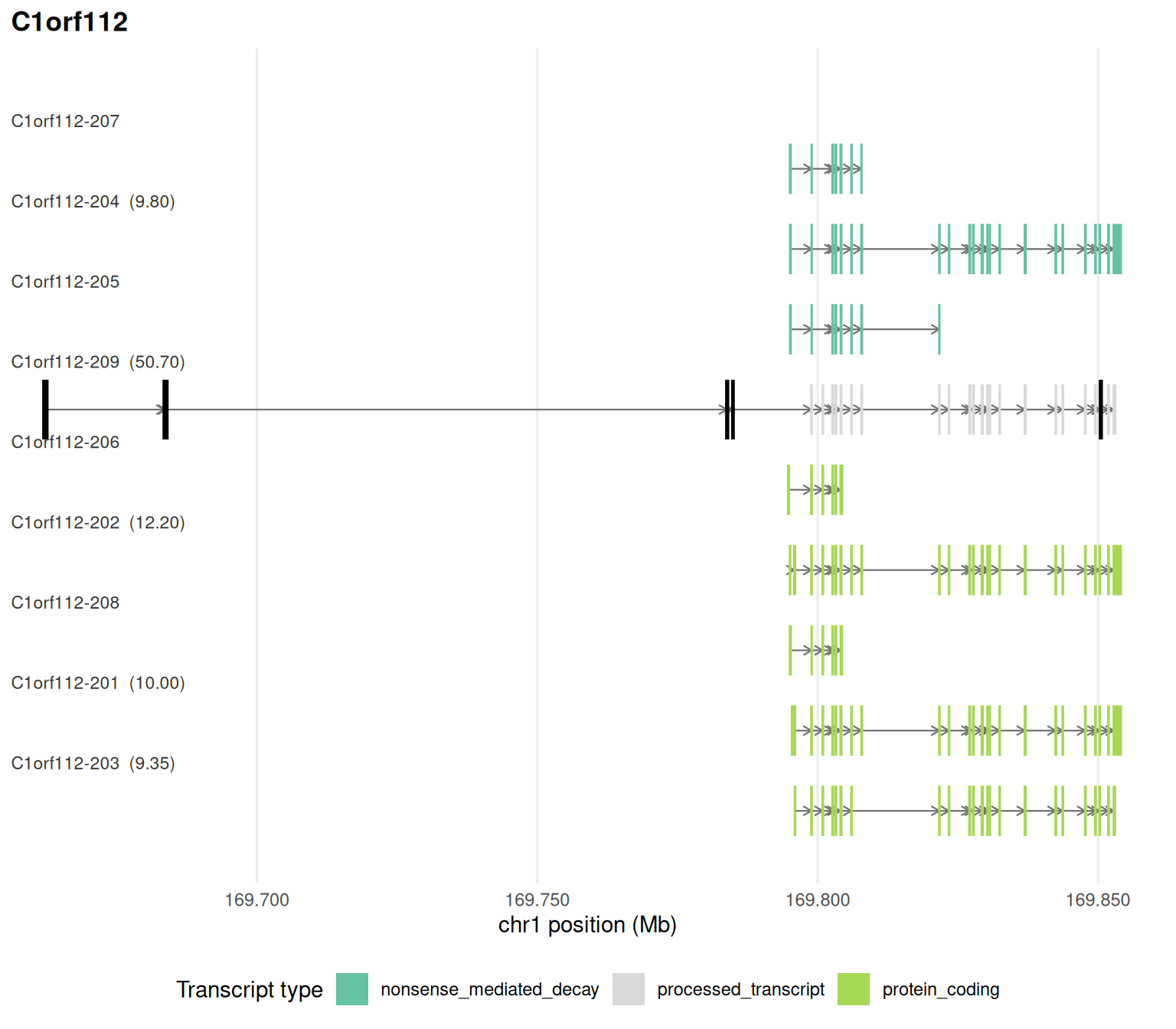
External evidence from frozen datasets
Observed translation and decay beat rules. The package pins versioned evidence tables (frozen_datasets()) that are downloaded once from the first mirror that has them, or rebuilt from their sources (data-raw/README.md in the repository documents the procedure), and joined into the annotation; transcript_productivity() then reports source = "evidence" for the transcripts they cover:
frozen_datasets()[, c("name", "version")]
#> # A tibble: 6 × 2
#>   name                version
#>   <chr>               <chr>
#> 1 appris              e113v49
#> 2 appris_domains      e113v49
#> 3 riboseq_orfs        phase1_phase2
#> 4 nmd_exons           karousis2021
#> 5 polyasite           2.0_GRCh38.96
#> 6 gtex_transcript_tpm v8
add_appris(iso)          # APPRIS principal isoforms and method scores
add_riboseq_orfs(iso)    # GENCODE Ribo-seq ORFs: translated main ORFs and uORFs
add_nmd_exons(iso)       # NMD-inducing exons validated by NMD inhibition
transcript_productivity(iso, gene_name = "RBPJ")[, c("transcript_name", "productivity", "reason", "source")]

# Pfam domains retained, partial or lost relative to the canonical isoform
domain_retention(iso, gene_name = "RBPJ")

# Healthy-tissue baseline: productive fraction and dominant isoform in GTEx
ref <- gtex_reference(iso, tissue = "Whole Blood")
productive_fraction(iso, group = "condition", reference = ref)
The evidence columns are consulted in a fixed order: a productivity_evidence column overrides everything, then a validated NMD exon, then a translated main ORF, then APPRIS principal status. Any other per-transcript evidence is attached with add_annotation_columns().
To reproduce an analysis with one deposit of the frozen files, pin the mirror before calling the add_*() functions (see ?isoformic-options):
options(isoformic.frozen_mirrors = "https://zenodo.org/records/<record>/files/")Session information
sessionInfo()
#> R version 4.6.2 (2026-10-29)
#> Platform: x86_64-pc-linux-gnu
#> Running under: Ubuntu 26.04.1 LTS
#>
#> Matrix products: default
#> BLAS:   /usr/lib/x86_64-linux-gnu/openblas-pthread/libblas.so.3
#> LAPACK: /usr/lib/x86_64-linux-gnu/openblas-pthread/libopenblasp-r0.3.32.so;  LAPACK version 3.12.0
#>
#> locale:
#>  [1] LC_CTYPE=C.UTF-8       LC_NUMERIC=C           LC_TIME=C.UTF-8
#>  [4] LC_COLLATE=C.UTF-8     LC_MONETARY=C.UTF-8    LC_MESSAGES=C.UTF-8
#>  [7] LC_PAPER=C.UTF-8       LC_NAME=C              LC_ADDRESS=C
#> [10] LC_TELEPHONE=C         LC_MEASUREMENT=C.UTF-8 LC_IDENTIFICATION=C
#>
#> time zone: UTC
#> tzcode source: system (glibc)
#>
#> attached base packages:
#> [1] stats     graphics  grDevices utils     datasets  methods   base
#>
#> other attached packages:
#> [1] dplyr_1.2.1          isoformic_0.1.2.9022
#>
#> loaded via a namespace (and not attached):
#>  [1] Matrix_1.7-6        gtable_0.3.6        jsonlite_2.0.0
#>  [4] compiler_4.6.2      tidyselect_1.2.1    Rcpp_1.1.2
#>  [7] parallel_4.6.2      scales_1.4.0        BiocParallel_1.46.0
#> [10] yaml_2.3.12         fastmap_1.2.0       lattice_0.23-1
#> [13] ggplot2_4.0.3       R6_2.6.1            labeling_0.4.3
#> [16] generics_0.1.4      curl_8.1.0          knitr_1.52
#> [19] tibble_3.3.1        DBI_1.3.0           RColorBrewer_1.1-3
#> [22] pillar_1.11.1       rlang_1.3.0         fastmatch_1.1-8
#> [25] utf8_1.2.6          xfun_0.62           fs_2.1.0
#> [28] S7_0.2.2            otel_0.3.0          cli_3.6.6
#> [31] withr_3.0.3         magrittr_2.0.5      grid_4.6.2
#> [34] digest_0.6.39       fgsea_1.38.0        cowplot_1.2.0
#> [37] lifecycle_1.0.5     vctrs_0.7.3         data.table_1.18.6.1
#> [40] evaluate_1.0.5      glue_1.8.1          farver_2.1.2
#> [43] duckdb_2.0.0        codetools_0.2-20    rmarkdown_2.32
#> [46] tools_4.6.2         pkgconfig_2.0.3     htmltools_0.5.9